

The Bondi Beach attack was a nightmare made real. Fifteen people were murdered during a Hanukkah celebration in Sydney. An act of antisemitic that ripped through a community in their moment of joy and left the world reeling with grief. We should have come together in that grief. We should have stood with our Jewish neighbors without hesitation. Instead, within hours, something else took hold: Islamophobia.
I need you to understand what happened next, because it matters deeply to all of us who believe communities can hold space for both truth and compassion.
In the United States, Alabama Senator Tommy Tuberville declared on social media that “Islam is not a religion. It’s a cult” and called for the deportation of Muslims.
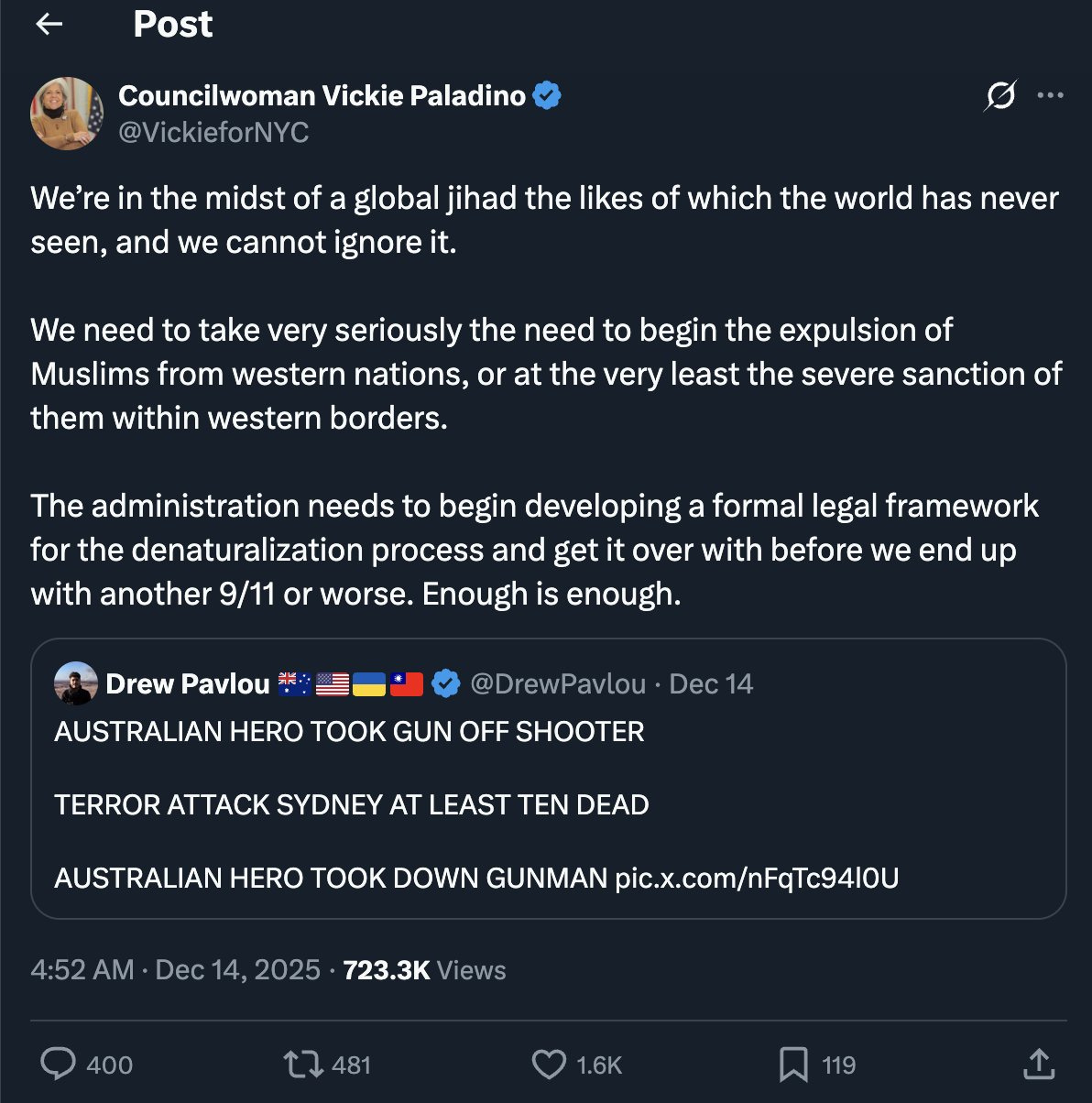
In New York City— where more than a million Jews and hundreds of thousands of Muslims share neighborhoods, schools, and subway cars—a Republican city councilmember demanded the “expulsion of Muslims from western nations.” The post was deleted after widespread condemnation, but you can’t unsay what’s been said. The speed of it tells you everything.
Online, the frenzy was worse. Misleading posts claimed that a Christmas fireworks display in Australia was Muslims “celebrating” the shooting. It wasn’t. Organizers confirmed the event was pre-planned and unrelated. Strangers’ photos were stolen and weaponized.
This is what we’ve come to recognize: violence happens, Muslims are presumed guilty, and before anyone can catch their breath, Islamophobia rushes in to fill the space where facts should be.
The geopolitics followed their own ugly script. Israeli Prime Minister Benjamin Netanyahu condemned the attack but also blamed Australia’s government, claiming that recognizing a Palestinian state had “poured fuel on the antisemitic fire.” Australian Prime Minister Anthony Albanese pushed back, making clear that Australia’s foreign policy had no connection to domestic terrorism and reaffirming his country’s support for Jewish Australians.
That exchange matters. But here’s what got lost in all of it. One of the people who stopped an attacker was an Australian Muslim father of two named Ahmed al-Ahmed. He tackled one of the shooters, disarming him saving lives and getting wounded in the process.
That detail was reported. And then it vanished beneath the noise of blame and fear and political posturing. Muslims became the targets of suspicion before they could be recognized as heroes—even when they were literally the heroes.
Naming the Muslim man who intervened isn’t about balance or good PR. It’s about telling the truth. When we erase Ahmed al-Ahmed’s actions while amplifying suspicion of Muslims broadly, we’re telling a lie about reality. We’re saying Muslims are threats, never protectors. Suspects, never heroes. It flattens the complexity of human beings and denies the public an honest account of what happened.
In April 2024, a stabbing at Bondi Junction sparked nearly identical Islamophobic speculation. Social media users rushed to label the attacker an “Islamist” terrorist before authorities said anything. The claim was baseless. Researchers documented the surge of anti-Muslim and anti-immigrant rhetoric that flooded online spaces immediately, with Islam invoked to explain violence without a shred of evidence. Advocacy groups warned that the far right was exploiting tragedy to advance narratives they’d been preparing all along.
The script was already written. When violence came to Bondi again, Islamophobia didn’t need to be created. It just picked up where it left off.
Recognition matters for our safety. When we acknowledge Muslim courage publicly, we interrupt the automatic mental link between Islam and violence. Muslims, like everyone else, act with compassion, bravery, and moral clarity when crisis demands it. Ahmed al-Ahmed proved that. We owe him the dignity of saying so.
The suspects were yes, a Muslim father and son, aged 50 and 24, authorities have said. The older man, whom state officials named as Sajid Akram, was shot dead. His son was being treated at a hospital. Police say the shooting targeted a Jewish celebration and that the suspects were influenced by ISIS—a violent extremist group—while stressing that the attack should not be used to fuel hatred against Muslims or any community.
A GoFundMe campaign for Ahmed raised over a million dollars, and Jewish donors sent heartfelt notes along with their donations, reports the Times of Israel.
Telling the full story—including Ahmed al-Ahmed’s name and what he did—isn’t generous. It’s not a favor to Muslims or an accommodation. It’s what journalism requires. It’s what the community demands. It’s what truth looks like when we choose it over fear.