


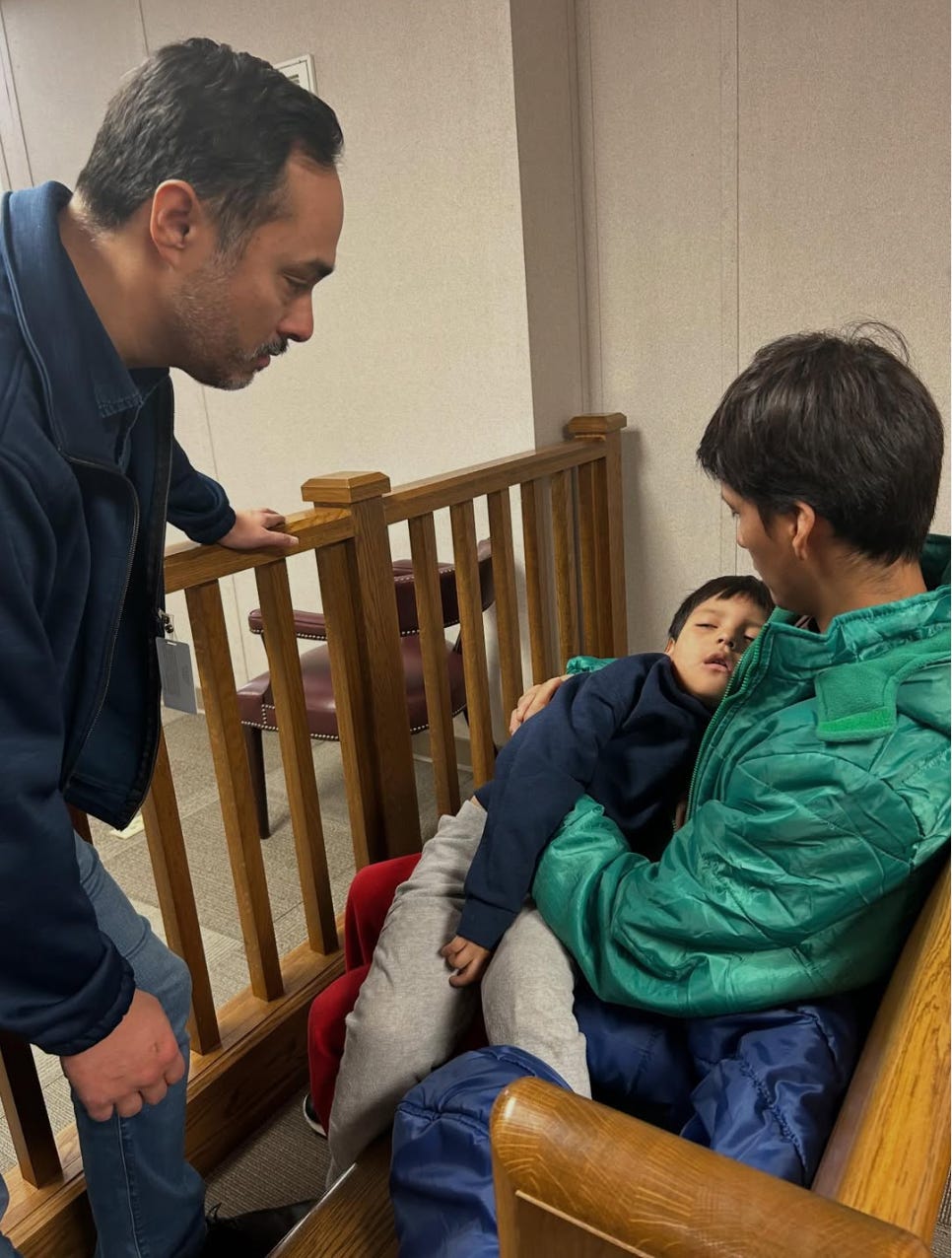
At a press conference in Texas today, members of Congress, advocates, and community leaders stood shoulder to shoulder with a single demand: Bring Liam home.
There’s a particular cruelty in being taken from your life and told nothing about what comes next and that’s the thread running through the story of Liam Conejo Ramos, a five‑year‑old boy now held in federal immigration custody at the South Texas Family Residential Center in Dilley.
The press conference, led by Reps. Joaquin Castro and Jasmine Crockett who visited the Dilley detention center, alongside community advocates, came amid renewed concerns about Immigration and Customs Enforcement (ICE) practices—particularly the targeting of families through courts, schools, and homes.
“This is not an isolated case,” Castro said. “Liam is not the first, and he won’t be the last.”
Liam’s detention has ignited public outrage, not because it’s unique, but because it has become a stark, human symbol of a detention system roiling back to life.
Liam and his family are from Ecuador and came to the United States in 2024 seeking asylum. School officials in Columbia Heights, Minnesota say that on January 20, federal immigration agents detained Liam and his father, Adrián Conejo Arias, outside their home after school, allegedly directing the boy to knock on the front door— a tactic described by local officials as “essentially using a 5‑year‑old as bait” to draw others out.
His mother, who is four months pregnant and also at the home that day, did not open the door—fearful of being detained herself—and has remained behind, separated from her husband and young son.
Since their arrest, a federal judge has temporarily barred ICE from removing or transferring Liam and his father while litigation proceeds, reigniting questions about the legality and humanity of detaining children with their families.
A Child Asking for His Backpack
At the press conference, Congressman Castro recounted that Liam kept asking for his backpack and his baseball cap—small childhood details that underscore how abruptly his life was upended. Castro also shared that Liam is depressed, refuses food, and sleeps a lot.
How Detention Is Funded and Structured
Family detention centers like Dilley are funded through federal ICE contracts, paid for by taxpayer dollars via the Department of Homeland Security. The bulk of ICE detention beds are operated by private prison companies such as CoreCivic and The GEO Group, which collectively receive hundreds of millions of dollars annually from those contracts. Because these companies are publicly traded, institutional investors — including large asset managers like BlackRock — hold significant shares in them, meaning the profits of detention flow into broader financial markets even as children are confined miles from home. This financial ecosystem helps explain why detention capacity can expand even when evidence shows it is harmful and counterproductive.
“Imagine Being a Child and Waking Up in Detention”
Representative Jasmine Crockett spoke plainly about what she witnessed at the Dilley facility.
“Imagine you’re a free‑willed kid,” she says about Liam, “and one day you’re put on a plane. You have one pair of pants and one shirt. Your father washes your clothes overnight. You don’t understand why.”
She described children who had stopped eating and a 16‑year‑old caring for four younger siblings after months in custody—far longer than the 20‑day benchmark that courts have said is the maximum reasonable period for holding children in immigration detention.
“What will it take for this country to have a wake‑up call?” she asked.
A Broader Pattern of Enforcement
Liam’s detention is not an isolated occurrence. After family detention centers were largely closed under earlier policies, the Trump administration’s enforcement build‑up in 2025 reopened facilities like Dilley and intensified sweeps across the country. In cities like Minneapolis and San Antonio, ICE operations have surged, resulting in thousands of arrests and growing community fear.
At the end of June 2025, roughly 58,000 people were in ICE custody, a 51 percent increase from the prior year, and about 90 percent were held in facilities managed by for‑profit firms.
Family detention, which is widely criticized by pediatricians, psychologists, and human rights advocates for its damaging effects on children’s mental health and development, has quietly re‑entered the enforcement toolkit. Rather than being a short‑term holding pattern, it has become a prolonged reality for many families caught in the immigration system.