

On November 3, we’re deciding who runs Congress for the rest of Trump’s second term. The House could come down to just a few races, and some of the closest are here in New York. That’s where the mainstream media will be looking. Hardly anyone will be watching the State Senate races on the same ballot, but they should be.
In New York, state senators will vote on whether New York redraws its congressional map for 2028. They’ll also write the budget that decides how the state handles federal cuts to Medicaid and immigrant services. There’s another story in these races, too. Democratic socialists won primaries across New York this year, from Congress all the way down to the legislature, in the same year Zohran Mamdani became mayor. And they won on ideas the party establishment once called career-ending.
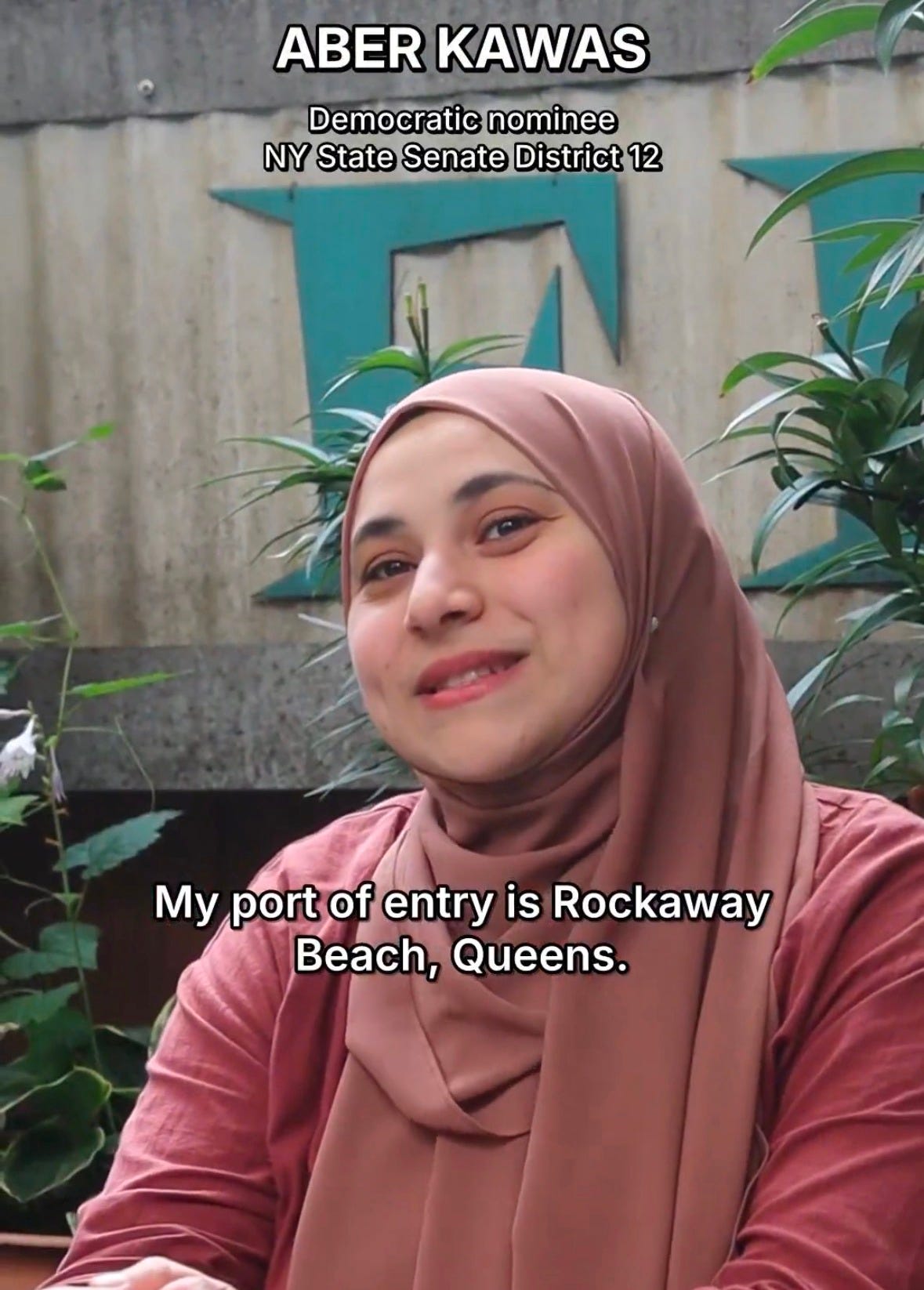
The daughter of once-undocumented Palestinian refugees, Aber Kawas helped write one of them. She’s the Democratic nominee for the 12th Senate District, an open seat in western Queens that covers Astoria, Long Island City, Sunnyside, Woodside, and Maspeth and she’s poised to be the first Palestinian Muslim woman in the state legislature.
Most coverage of immigrants this year has been about enforcement and crisis. Kawas’s story is about what comes next: the children of immigrants stepping into power.
This conversation has been edited for length and clarity.
What’s your port of entry?
Rockaway Beach, Queens. It’s where my parents first lived when they came here, and I only found out in fourth grade, after a sleepover at a friend’s house out there. A lot of immigrants land in Rockaway. My mom’s first memory of America is a storm there. She could hear the waves crashing, and it scared her. She grew up in Jordan and had never lived near the ocean.
And before Rockaway?
My mom was born in Tulkarm, in Palestine. My dad was born in Jordan after his family was displaced in 1948, and my mom’s family settled there after 1967. So the real port of entry is the Nakba. That’s the story of the Palestinian people. Most of us have lived generations outside of Palestine.
We both grew up Muslim in the era of 9/11. What’s your story?
I was in fourth grade. What I remember is the days after. When we came back to school, we sat in a circle to debrief, and my teacher looked at me like I should explain what happened. Suddenly I was so aware that I was Muslim, that I was othered, that I had to answer for something I had nothing to do with. That stayed with me.
How did that shape what came next?
I saw how it hit our community. My parents were undocumented, and I remember them talking about whether to leave before they got rounded up. My dad was in ICE detention in 2005, and he was eventually deported.
It’s 2026, and ICE is bigger and better funded than ever, a rogue agency kidnapping and killing people. More than twenty years later, we aren’t even fighting to expand immigrant rights. We’re fighting to make sure immigrants don’t get kidnapped and killed. That’s part of why I’m running.
There’s no blueprint for the child of undocumented parents going into politics. How did you find your way in?
My mosque, when I was eleven. There was programming for teenagers and a room for little kids, so I went to the leadership and told them they needed something for pre-teens. It sounds funny, but that is organizing: you see a problem, find a solution, and work with others to make it happen.
After my dad was deported, I was a youth intern at the Arab-American Association, and Linda Sarsour invited me to speak at a rally for the DREAM Act. My brother was undocumented, so I told his story. I took a three-hour bus ride to the state legislature, told it in a cramped room, and got the thank-you nod. Thank you for telling your story. But I’m not going to do anything about it.
That’s a sobering thing to learn young.
I carry it with me. We need people with lived experience in power because they’ll have empathy. That’s true. But you also need your own base of power, because there are people in power who can hear your story and not care.
Most people will spend this election thinking about Washington. Make the case for Albany.
So much of it is the budget. That’s where it’s decided how much goes to education and transportation, and sometimes a housing policy that can’t pass on its own moves through the funding.
The state is also the intermediary between the federal government and the city. When Trump slashes Medicaid, it falls to the state to fill the gap. When an administration is trying to make immigrant and working-class lives worse, the state has to keep people from losing their livelihoods.
What did you hear most from voters?
Overwhelmingly, affordable housing. Rent eating whole paychecks and going up every year. We need housing people can actually afford, not beautiful buildings the neighborhood can’t move into.
This district, where I grew up and still live, has a lot of new housing going up. But who’s it for? I’m middle-class and white-collar, and I feel like I can’t afford to raise my own kids here.
Exactly. We need to pass the Social Housing Development Authority and the tenant powers act, so tenants have rights and new housing is priced to what people earn. People blame newcomers for gentrification, but it’s a policy question.
And it’s all connected: fast, free buses, universal childcare, universal healthcare. If you’re not drowning in those costs, you have room for rent and a dignified life. Government can deliver on every part of your life at once. Instead we spend two years on one housing bill that doesn’t get implemented while healthcare gets pushed a decade down the line.
You helped write a now-famous bill.
The Not on Our Dime Act, introduced with then-Assembly Member ZohranMamdani and Senator Jabari Brisport. It targeted the millions raised in New York and sent to settlers to take Palestinian land and commit human rights abuses. We thought it was clear-cut. People called it fringe and said it would end the career of everyone who touched it.
Now so many people who won primaries this year ran on endorsing it, a bill that three years ago had almost no support. It set a precedent: people want elected officials to act on policy that’s for humanity. I’m looking forward to co-sponsoring it in office.
What does this democratic socialist moment mean beyond New York?
New York sets precedents. These primary wins show people are fed up with the status quo. A lot of us are differentiating ourselves from a Democratic Party that didn’t speak out against the genocide of Palestinians, hasn’t done enough to block money going to war, and hasn’t fought hard enough for immigrants, to abolish ICE, or for affordability. We’re fighting a fascist administration, which is exactly why we need bold representation. If we’re not bold, our voters get disillusioned.
What does it mean to you, as the child of undocumented immigrants, to be on track to become the first Palestinian Muslim woman in the state legislature?
When I won the primary, my dad said, “I’m so glad that after all of our trouble, you were able to channel that into helping other people.” That’s what it means. Representation only matters if people listen to you. A Palestinian who has spoken out for Palestinian liberation getting voted in shows that’s what people actually want. You get to represent more than the community you come from.
Anything I didn’t ask?
My coffee order. [laughs] Really, I’m honored this is in Queens. We kept saying it on the campaign: “the world’s borough.” People here are connected to people all over the world. We can’t hold privileges at the expense of others. That’s what called to voters, and it’s what I’m proud to be part of.
The general election is Tuesday, November 3, 2026, and early voting runs October 24 through November 1.