


Juneteenth is, without argument, the true Independence Day of the United States of America. For 89 years after July 4th, Black Americans were still enslaved. Black communities have celebrated June 19th since 1866—for generations before the rest of America acknowledged it existed. Many immigrant communities still don’t know what it is—even though the Black freedom movement it represents is the reason most of us were ever allowed into this country at all.
On June 19, 1865, Major General Gordon Granger arrived in Galveston, Texas with around 2,000 Union troops and delivered General Order No. 3, announcing to more than 250,000 enslaved Black people that they were free. The Emancipation Proclamation had been issued two and a half years earlier. But without Union soldiers to enforce it, the law had been meaningless in Texas. Plantation owners had simply continued as before, capitalizing on free black labor.
This is the first thing immigrant communities need to understand about this country: America has a long precedent of curtailing the freedoms that people of color are owed. The allure of Western amenities, the promise of the American Dream, the relief of having made it here at all—these things lead immigrants, again and again, to turn a blind eye to that reality.
The Myth That Was Built to Divide Us
When we arrive in the United States, we are handed a racial hierarchy. Too often, we assimilate by internalizing the very anti-Blackness that oppresses the people who paved our way.
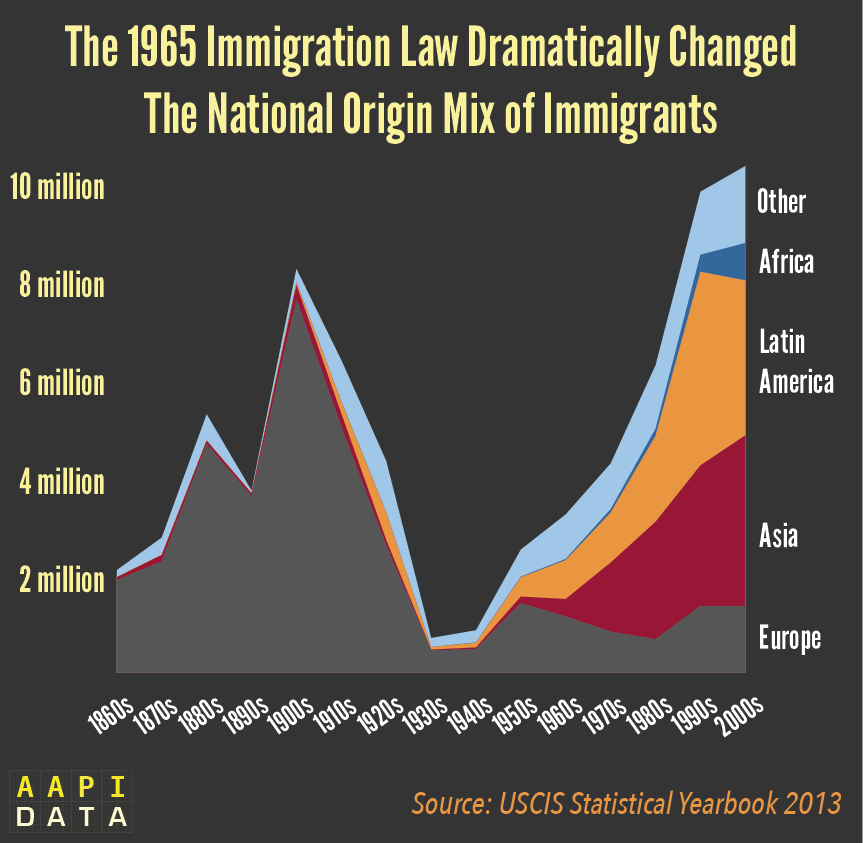
If your immigrant family arrived after 1965, you have a direct connection to black history. Before the Immigration and Nationality Act of 1965, U.S. immigration policy was built on a quota system that heavily favored Northern Europeans. The Civil Rights Movement produced the Civil Rights Act of 1964, which outlawed discrimination based on national origin. Once that principle was established domestically, discriminatory immigration quotas couldn’t stand. Attorney General Robert Kennedy said at the time, “everywhere else in our national life, we have eliminated discrimination based on national origins, yet this system is still the foundation of our immigration law.”
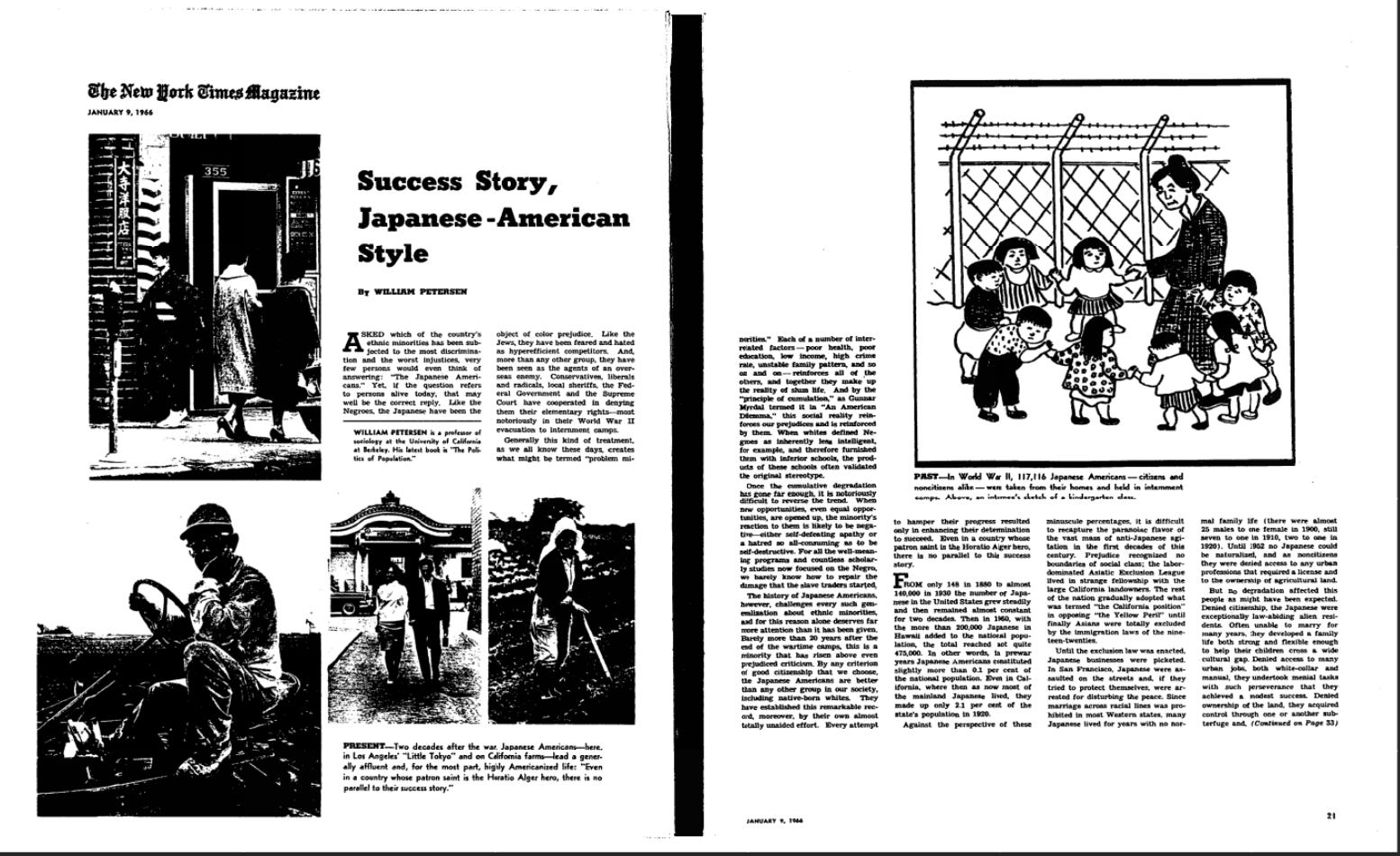
On January 9, 1966, at the height of the Civil Rights Movement, UC Berkeley sociologist William Petersen published a piece in the New York Times Magazine titled “Success Story, Japanese-American Style.” The article argued that Japanese Americans had lifted themselves to success through hard work, family values, and respect for authority while explicitly labeling Black Americans “problem minorities.”
This story came out while Black Americans were in the streets demanding structural change in the civil rights era, and here was a major American publication offering a counter-narrative: look at these Asians, quietly succeeding. Why can’t everyone else do the same?
White politicians and media ran with it. The model minority myth became a tool used to flatten the real diversity of Asian immigrant experiences, erasing the poverty, the language barriers, the discrimination, the internment that Petersen himself had documented, in order to repackage Asian communities as evidence that the system worked. If Asian immigrants could make it, the argument went, then Black Americans demanding reparations, desegregation, and voting rights were simply making excuses.
The message handed to generations of immigrants since has been consistent: proximity to whiteness will reward you, but you have to position yourself against Blackness to earn it.
Complicity is Deadly
Immigrant entrepreneurs frequently open businesses in predominantly Black neighborhoods, where commercial rent is cheaper due to redlining and systemic disinvestment. Non-Black store owners profit in Black communities, while bringing their imported or learned anti-Black biases behind the counter with them.
And more often than not, this complicity becomes deadly.
Cyrus Carmack-Belton was 14 years old when Rick Chow, an Asian American convenience store owner in South Carolina, chased him down and shot him in the back in 2023. Chow had accused the unarmed teenager of stealing four bottles of water. A civil lawsuit filed by Carmack-Belton’s family alleges that Chow had a pattern of racially profiling and intimidating Black customers. On June 1st, 2026, the jury came back with a not-guilty verdict.
In 1991, Soon Ja Du, a Korean immigrant whose family owned the Empire Liquor Market in South Central Los Angeles, shot 15-year-old Latasha Harlins in the back of the head after accusing her of stealing a bottle of orange juice—even as security footage showed Harlins approaching the counter with money in her hand. Du was convicted of voluntary manslaughter but received no prison time—just probation, community service, and a $500 fine. The sentencing enraged Black Los Angeles and became a major flashpoint for the 1992 uprisings.
More than thirty years later, Cyrus Carmack-Belton is dead and Rick Chow is free, and we are still in the same cycle. Immigrant communities did not invent anti-Blackness in America. But we have participated in it, benefited from it, and too often said nothing about it.
The Holiday We Were Told Not to Know About
It took until 2021 for Juneteenth to become a federal holiday—156 years after those troops arrived in Galveston.
“Juneteenth is neither the beginning nor the end of something. The end of the Civil War and the ending of slavery didn’t happen overnight and was a lot more like a jagged edge than a clean cut,” explained Erin Stewart Mauldin, the John Hope Franklin Professor of Southern History at USF St. Petersburg and an expert on the Civil War and Reconstruction.
Immigrants walked through a door that Black Americans bled to open and we have to reckon with the full history of the country our communities have made their home.
The uncomfortable question Juneteenth asks immigrant communities is this: what will we do with the freedom that was won for us?