


Hi all!
I was on a reporting trip last week and was insane to think I could send this newsletter out on time so if you end up wondering why you’ll hear from me twice this week, that is why. This is a solo operation and sometimes a girl misses. But at least I’m authentic and not an AI agent right?
Moving on.
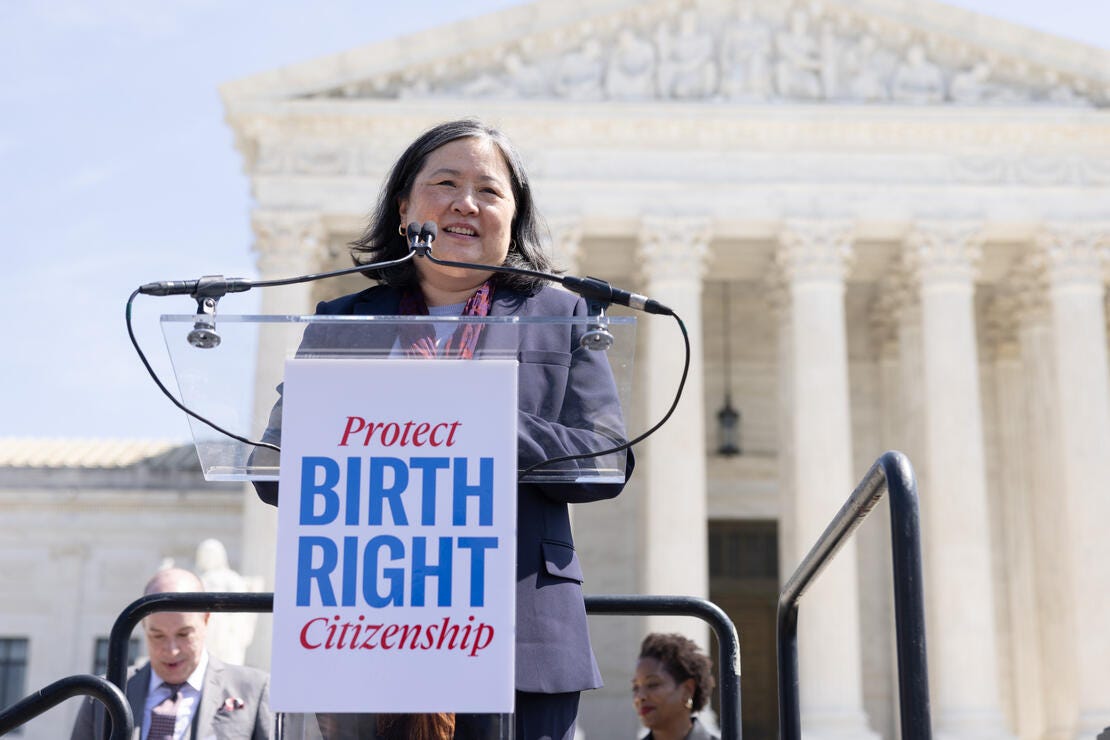
Last week, as the Supreme Court prepared to hear the most consequential immigration case in over a century, a woman named Cecillia Wang walked into that room and stood at the lectern. She is the national legal director of the ACLU, and a daughter of immigrants who was born in Oregon to Taiwanese grad students.
Under the executive order she was there to argue against, she would not be eligible to become an American citizen. She would not have been allowed to become the lawyer standing in that room, before those nine justices, with the president of the United States watching from the front row.
I don’t know how she felt walking in, but I know how I felt hearing her speak and reading about her life.
One of the first things President Trump did on his his first day back in office last year was President Trump sign an executive order ending birthright citizenship for children born in the United States to undocumented immigrants, and also for children of immigrants here legally but temporarily on student visas, work visas, or any non-permanent status.
An estimated 150,000 such children are born in the United States each year. Every federal court that has considered the order has struck it down and yet it still arrived at the highest court of the land—the Supreme Court.
The case turns on five words in the 14th Amendment: “subject to the jurisdiction thereof.” The government argues those words require a parent’s permanent allegiance and legal “domicile” in the United States, not just physical presence. The challengers argue that those words have meant one thing for 128 years: if you are born here, you are American.
The amendment says so. The Supreme Court affirmed it in 1898. Congress codified it in 1952.
What the Trump administration is asking the court to do, in the plainest terms, is treat one hundred of fifty years of constitutional law as a clerical error.
A First in American History
Trump is the first sitting president that has ever attended Supreme Court oral arguments. He sat in the courtroom for about 90 minutes while his Solicitor General, D. John Sauer, made the government’s case. He left less than 15 minutes after Cecillia Wang stood up to argue the other side.
On his way out, he posted on Truth Social, “We are the only Country in the World STUPID enough to allow ‘Birthright’ Citizenship!”
Like many things, Trump is wrong. There are nearly 33 countries (primarily in North and South America) that have birthright citizenship, including Canada, Mexico, Brazil, and Argentina.
What the Justices Said
The conventional read coming out of Wednesday is that the government lost the room. Not just with the liberal justices but with the conservatives too, including three of the four justices Trump himself appointed.
Chief Justice Roberts was the first signal. When Sauer argued that mass global migration represented a “new world” that the framers couldn’t have anticipated, Roberts didn’t pause, "It’s a new world. It’s the same Constitution.” He also called the government’s list of historical exceptions to birthright citizenship—children of foreign diplomats, children of enemy combatants— “very quirky,” and questioned how the government could leap from that “tiny and idiosyncratic group” to an entire class of immigrants.
Justice Gorsuch said it was “striking” how rarely the concepts of allegiance and domicile—the centerpiece of the administration’s argument—came up in the actual congressional debates when the 14th Amendment was being written and ratified. He later told Sauer, plainly, “I’m not sure how much you want to rely on Wong Kim Ark.” The 1898 case that first attempted to disprove a child of immigrants as a birthright citizen that the government was leaning on kept undermining them.
Justice Barrett pressed Sauer on the text itself, “You say the purpose of the 14th Amendment was to put all newly freed slaves on equal footing, but that’s not textual. So how do you get there?” She also asked why, if the framers had wanted to limit birthright citizenship based on parental status, they simply didn’t say so. When Sauer tried to pivot to foundlings—children of unknown parentage — Barrett cut him off mid-sentence, “Yeah, yeah, yeah. What about the Constitution?”
Justice Kavanaugh noted that the administration wasn’t just asking the court to reinterpret the 14th Amendment, it was asking them to overrule Congress, which had written birthright citizenship into federal immigration law in 1952. He rejected the government’s comparisons to other countries’ citizenship rules:, “We try to interpret American law with American precedent based on American history.” And on what would happen if the court simply followed the traditional reading of Wong Kim Ark, “This is a short opinion.” The room laughed.
On the other side of the bench, the liberal justices were equally unsparing. Justice Sotomayor cut through the government’s careful framing: “You’re asking us to overrule Wong Kim Ark. You’re asking us to overrule that case.” Justice Jackson returned repeatedly to a question the government never adequately answered, “Why is there nothing in the 14th Amendment about the parents?’ On enforcement, she was blunt, “Are we bringing pregnant women in for depositions?”
The only two justices expected to side with the administration are Thomas and Alito who directed most of their pointed questioning not at the government, but at Wang.
What Comes Next
Birthright citizenship is still the law. The executive order has never gone into effect and every court that has considered it has blocked it. The Supreme Court is expected to rule on it by early summer.
Most legal observers now expect the court to strike the order down. The question is the margin — whether it is 7–2, 6–3, or a narrower 5–4 that leaves more room for future challenges. The margin matters because a narrow ruling is a door left slightly open.
But a ruling in our favor doesn’t erase what happened Wednesday. The argument that some of us born here carry a lesser claim to this country, that our parents’ visa status is our inheritance, that American-ness can be means-tested at birth—that argument was made out loud, in the highest court in the land, with the president of the United States in the front row nodding along.
Birthright citizenship wasn’t written into the Constitution until 1868, to overrule the Supreme Court’s Dred Scott decision, which had declared that Black people—enslaved or free—could never be citizens. It took a constitutional amendment to undo that. It took a civil rights movement to make the promise even close to real.
The question of who belongs in America is very old. The answer has always had to be fought for.
I think the right has made their point very clear: they want a return to informal apartheid and explicit white dominance. Even though I don't think the citizenship question is likely to be resolved in their favor, I doubt they are likely to stop seeking the end result at the core of this case.
That's so heartbreaking. I spent some time looking into how things work in Germany, where there isn't unconditional birthright citizenship. I also looked at the US as a kind of model… It's really dark to watch that system starting to crack.