


On a Tuesday morning in February, with snow still on the ground from the day before, New York City school doors opened to 63 percent of students. The other 37 percent were home, their parents scrambling for coverage or quietly losing a day of work they couldn’t afford to lose. Mayor Zohran Mamdani had already used his one weather waiver. He couldn’t close schools again without jeopardizing the 180 days of instruction the state requires for maximum funding. So the buildings opened. Most of the city stayed home anyway.
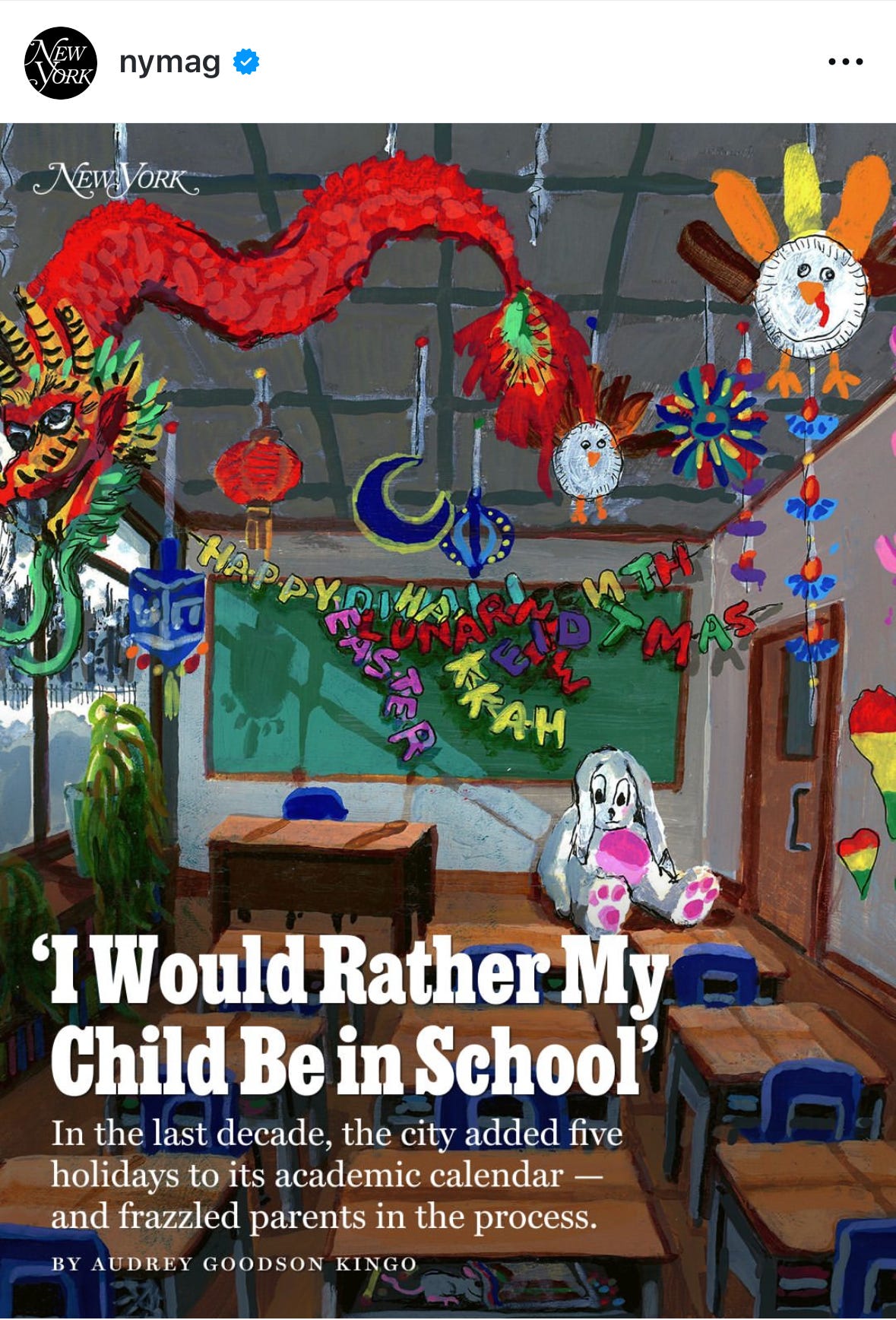
New York Magazine recently called this a crisis—and named the culprit: “religious and cultural holidays,” specifically the five added to the calendar in the last decade. Eid, Diwali, and Lunar New Year among them.
I’ve covered immigrant communities for fifteen years. I know this story and I've watched it get told, in variations, for years—the story where the arrival of new communities is framed as a disruption to a system that was, before they got here, working fine.
The double standard
For as long as there have been immigrant families in New York City, those families have navigated a school calendar built entirely around traditions that were not theirs. They arranged childcare for Christmas break. They stretched thin budgets across spring recess. They took unpaid days for Easter and winter recess and the professional development days that arrive without warning, because that is what you do when the system was not designed with you in mind.
The New York Magazine piece quotes one Asian American mother—a parent in Queens named Jean, who is Korean American, celebrates Lunar New Year, and would, she says, prefer her daughter be in school. Jean’s perspective is real and worth hearing. It is also the perspective of one parent, in a city of millions, from communities that fought for twenty years to see their children’s holidays recognized. The organizers of the Coalition for Muslim School Holidays are not quoted. The parents who kept their children home in protest, year after year, waiting for Diwali to be recognized—they are not in the piece.
Choosing one parent whose views confirm the article’s argument, from the communities the argument is about, is not balance. It is a familiar move, and journalists who cover these communities recognize it.
A calendar built by some, for some
The school calendar was never secular. That is the fact that tends to get lost in these conversations, and it is the place where this one has to start.
In the 19th century, American public schools ran on Protestantism. The King James Bible was standard classroom material. When Irish Catholic immigrants arrived in waves, Archbishop John Hughes of New York pushed back so fiercely against the forced religious assimilation that Catholics eventually built their own parallel school system rather than submit their children to it.
Jewish holidays weren’t added to the New York City school calendar until 1960 and not because the Board of Education grew a sudden conscience. By then, Jewish teachers and students made up such a significant portion of the city’s school system that absenteeism on Rosh Hashanah and Yom Kippur had made the buildings functionally inoperable. The calendar changed because the demographic reality left no other choice.
What happened next followed the same logic, just slower.
Decades of fighting for a seat at the table
The push for Eid al-Fitr and Eid al-Adha began in earnest in 2006, when the state of New York scheduled a mandatory statewide exam on the holiest day of the Muslim calendar. The Coalition for Muslim School Holidays organized for nearly a decade before Mayor Bill de Blasio added Eid to the calendar in 2015 — for a city where, by then, an estimated one in eleven New Yorkers was Muslim.
Lunar New Year came the same year, after years of advocacy by Asian American community leaders including U.S. Rep. Grace Meng and City Councilwoman Margaret Chin, who had spent years documenting the absurdity of a system that handed out unexcused absences to children for celebrating with their families. Asian American students now make up more than 15 percent of New York City’s public school enrollment.
Diwali took the longest. Two decades of organizing, including parents pulling their children from school en masse as deliberate acts of protest, before Assemblywoman Jenifer Rajkumar—the first Hindu American elected to New York State office—helped push it into law in 2023. More than 200,000 Hindu, Sikh, Jain, and Buddhist students are affected.
The New York Magazine piece acknowledges some of this history but what it doesn’t give any weight to is the years of of grinding, multi-decade campaigns by communities that had spent years watching their children penalized for practicing their faith, then finally demanding the same recognition that had long been extended to others.
The real scapegoat
Consider what the article’s own reporting reveals. A mother on the Upper West Side spends more than $4,100 a year on holiday camp for her two children. That number is cited as evidence of the calendar’s cost—but it reflects the full calendar: Christmas break, winter recess, spring break, professional development days, snow days. Eid and Diwali are recent additions to a list of closures that predates them significantly.
The piece notes that only 41 percent of large private U.S. companies observe Juneteenth as a paid holiday — and far fewer offer Lunar New Year, Eid, or Diwali. The article treats this as background detail. It isn’t. It’s the whole point. Working parents are struggling because their employers were never required to accommodate anything outside a traditionally Christian calendar. That’s not a school problem. That’s a corporate culture problem—and blaming the school calendar lets it off the hook entirely.
The absence of national paid leave policy surfaces briefly when Rachel Kessous, a public-high-school teacher in Brooklyn is quoted saying, ‘”our country is clearly not set up to support working families, but the issue is not with the DOE calendar; it’s with our inability to take off work when needed to support and spend time with our families.” The return-to-office mandates that have stripped away the flexibility that once made school closures manageable get a sentence. These are noted and moved past.
The piece compared New York unfavorably to Los Angeles, Chicago, Seattle, San Francisco, Boston, and Washington D.C.—cities that close for fewer holidays—and documented the financial strain on working parents in detail. What the piece spent less time on is the city’s school day—at 6.3 hours compared to the national average of 6.9—is among the shortest in the country, a fact mentioned once, in passing, without examining how much of the 130-hour instructional gap it explains.
The constraints are real and the calendar is genuinely tight. None of that changes the fact that when major outlets frame inclusive holidays as the primary source of a working-parent crisis, they provide cover for exactly these kinds of reversals—and ask the communities who fought hardest for recognition to be the first ones to give it back.