


I
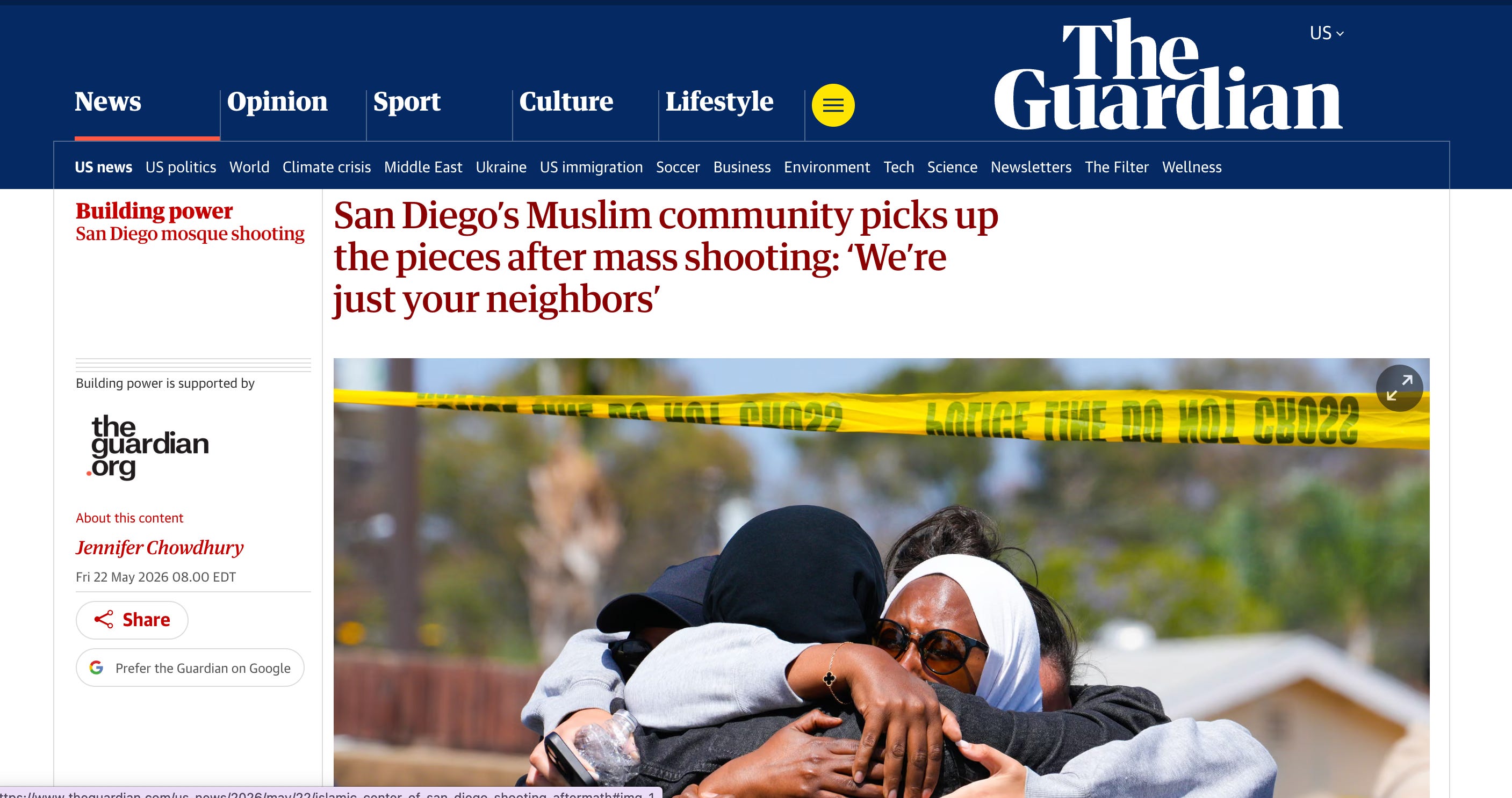
I have spent most of this week immersed in the aftermath of the horrific mass shooting at the Islamic Center of San Diego, reporting a piece on the community for The Guardian.
On Monday morning, two teenagers walked up to the Islamic Center with guns and a manifesto. A security guard named Amin Abdullah stopped them before they could reach the 140 children inside. He died in the parking lot. So did two other men from the community—Mansour Kaziha, the mosque store manager, and Nader Awad, who heard the shots and ran toward them to protect the children and teachers.
I have been a journalist for two decades. I have reported from refugee camps and detention centers; I have followed ICE as they patrolled the streets. I cover Muslim and immigrant communities because I firmly believe that the stories of people at the margins of American life are, in fact, the story of America itself. I thought, by now, I would know how to hold this work. I was wrong.
The Guardian piece—a reported look at the Islamic Center, the imam who spent twenty years keeping its doors open, and the community that built it—touches on the anti-Muslim hate that led to this moment. I am grateful to my editors for letting me report on the full scope of this tragedy.
But there is something I needed to write that I couldn’t file to an editor. Something about what it means to do this work as a Muslim journalist and as a mother, in a country where the political and the personal have become impossible to separate. A country where the threat environment our children are growing up in is not merely a backdrop, but the story itself.
That’s what Port of Entry is for. It’s below.
“Seconds felt like hours,” Ms. Imani, a teacher’s assistant at the Islamic center’s elementary school, told me. She was describing the forty minutes she spent huddled under a desk in the dark, reciting her shahada, listening to shooters move through the hallway of the school where she works. I have conducted hundreds of interviews in twenty years of reporting. I have rarely had to stop and actively remind myself which role I was in—journalist or mother.
This is what it takes to keep Muslim children safe in America in 2026: men like Amin, Mansour, and Nader rushing toward gunfire.
When police finally evacuated the school, the staff ran to a nearby church that served as the safe zone. As the children came bursting through the doors—some in shock with wide eyes, some sobbing, some running straight into each other’s arms—the teachers did something Ms. Imani described quietly, almost as an aside: they wiped their own tears first. “It was so hard to keep on that brave face,” she told me. “But the children are the ones who gave us the strength.”
I keep coming back to the children. They knew exactly what to do because they had practiced. A school attached to a mosque, in a country that makes its children run active-shooter drills, has already told those children something very specific about what the world thinks of them. They learned to pray and they learned to hide. Both are survival skills now.
“The kids loved Amin Abdullah,” Tazheen Nizam, executive director of Council of American Islamic Relations San Diego, told me. He stood at that door every single day, greeting them with a smile. He was funny. He was jovial. And now he is gone, and they will walk past the empty space where he used to stand.
That he was there at all is worth examining. In recent years, mosques across the country have relied on the Department of Homeland Security’s Nonprofit Security Grant Program to fund physical security—cameras, barriers, trained personnel. Nizam told me that no mosque in San Diego County received a grant in the last funding cycle. The application process, she explained, has become entangled in conditions that make Muslim institutions wary. Requirements linked to immigration enforcement cooperation create an atmosphere of scrutiny that turns federal protection into a potential liability. So, communities make do. They find a brave man willing to stand at the door. They train their three-year-olds to crouch in corners and stay silent. They pray it is enough.
The defunding of mosque security does not exist in isolation. Hatem Bazian, director of the Islamophobia Research and Documentation Project at UC Berkeley, has been tracking the political environment that produced Monday’s shooting for two decades. What he describes is not a spike, but a structural transformation. An anti-Sharia caucus in Congress has grown to more than 60 members. Republican-led campaigns have targeted Muslim institutions in Texas, Florida, Minnesota, and New Jersey. The war with Iran and Israel’s ongoing military campaign in Gaza have intensified anti-Muslim sentiment and violently narrowed the political space for Muslim American voices. Every lever of civil society, Bazian told me, has been weaponized—and religious institutions are not exempt. “The rhetoric that was previously confined to the fringe,” he said, “is now spoken openly from the floor of Congress and amplified by figures with proximity to the executive branch.”
It is not a coincidence that this is happening as the country grows more diverse, more multiracial, more multireligious—and as the political response to that diversity grows increasingly hostile. The communities most targeted by hate violence are the exact same communities being quietly cut off from the resources that might protect them. Bazian calls this the integration bargain that was never a bargain at all. “American Muslims,” he told me, “are citizens on probation. They must demonstrate in small and large ways that they deserve citizenship.”
I was a teenager when the towers fell. Like every Muslim American of my generation, September 11 marked a before and an after. It reorganized how we moved through the world, how we explained ourselves, how we learned to make ourselves legible to a country that had suddenly decided we were a question it needed to answer. I became a journalist, in part, because of that rupture. I believed that stories were a form of repair. That if enough people understood what Muslim and immigrant families in America were actually living, something would shift.
I still believe that.
But I am also a mother now. When Ms. Imani described crawling under that desk and saying her shahada while listening for footsteps in the hallway, I wasn’t only a journalist processing a source’s account. I was a Muslim mother to a two-year-old and a five-year-old.
Nizam said something to me that I haven’t been able to shake. She was talking about what parents are living with—the sheer dread of a drill notification, the mental math that happens every single morning. “You never think: has the school done an active shooter drill? Are they up to date on security?“ she said. “You’re thinking: do they have their lunch? Do they have their sweater?“
Nizam put it plainly: the children who grew up in the years after September 11 are still reeling from that rupture. And now, twenty years later, they are desperately trying to protect their own children from something even more immediate. Generational trauma doesn’t stay in its lane. It compounds. It accumulates. It passes through the body and lands in the next generation whether we want it to or not.
Fellow children of immigrants, the more we add our language, our food, our grief, our joy, our faith to what America is—the more we are targeted for exactly that. We were promised that assimilation was the price of safety. We paid it. And we are still burying our people who died because of hate.
Our children should not have to be this brave. And neither should the men who died to protect them.
If this brought something up for you—share it. Forward this newsletter. Subscribe and support. Put it in a group chat. Give it to someone who doesn’t already know what Muslim families in this country are carrying.
That is what Port of Entry is here for.
— Jennifer