


This is a strange week to be turning 250.
On Tuesday, the Supreme Court told this country something it already knew: if you’re born here, you’re American. Two hundred and fifty years in, and we are still litigating the most basic question this country was ever built to answer: who gets to belong here, and who decides?
I was in Minneapolis last week, on Dakota land, and I kept thinking that this whole argument over citizenship—soil versus blood, who’s born here versus who arrived here—is a conversation that already assumes the soil was ours to claim in the first place. It wasn’t. Before there was a 14th Amendment, before there was a colony, this was Dakota land, and Ojibwe land, and hundreds of other nations’ land, none of whom were asked. Every version of “who belongs here” that this country has ever argued — 1790, 1965, 2026 — is a conversation happening on top of an answer nobody with power ever wanted to hear. I think it’s dishonest to talk about birthright and belonging in America without naming the fact that the whole framework, soil or blood, was built on a taking.
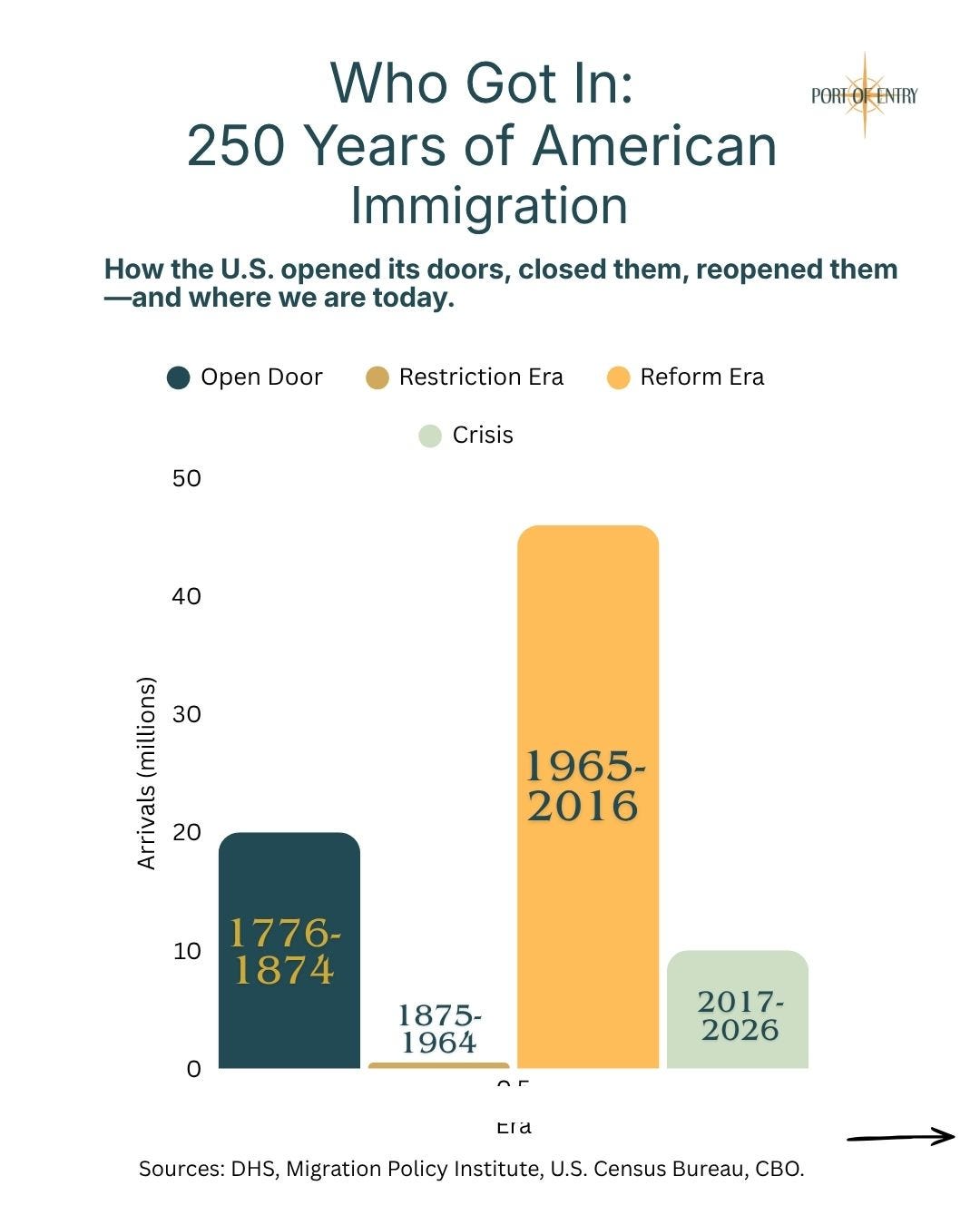
With that in mind, here’s how the door has actually moved over 250 years — open, shut, cracked, thrown wide, and slammed again.
Open Door (1776–1874)
For nearly a century, the United States barely bothered to lock the door. States decided who got in, not the federal government. But “open” never meant “equal.” The 1790 Naturalization Act made citizenship the property of “free white persons” only. And while roughly 20 million people walked through that open door—mostly from Britain, Germany, Ireland, Scandinavia — hundreds of thousands of Africans were dragged through it in chains, stripped from the immigration count entirely even as their labor built the country receiving everyone else.
The Restriction Era (1875–1964)
Between 1875 and 1964, America engineered a slow, targeted shutdown based entirely on race and nationality. Chinese laborers literally built the country’s railroads, yet they were the first group explicitly banned by name through the Chinese Exclusions Act of 1882. Fast forward to the 1920s, and new quotas deliberately slashed the number of Southern and Eastern Europeans allowed in. By World War II, the U.S. was locking Japanese Americans in internment camps. Add the Great Depression to the mix, and immigration plummeted: the 1930s saw just 528,000 arrivals, the thinnest decade the nation has ever recorded.
The Reform Era (1965–2016)
1965 changed who got to call themselves American. The Hart-Celler Act tore out the racial quota system and, for the first time, let Asia, Latin America, and Africa in on equal footing. The demographic floor of the country shifted under everyone’s feet—the foreign-born population quadrupled between 1970 and 2007. By 2022, 46.1 million immigrants called the U.S. home.
The Crisis Era (2017–2026)
The influx of immigrants and diversifying of America led to today’s backlash, is my humble opinion. Two Trump administrations frame this era. The current Trump administration has run the most aggressive immigration enforcement campaign in over half a century—interior deportations and street arrests increased in unprecedented numbers, refugee admissions slashed down. In 2025, more people left the United States than arrived.
As America turns 250, the only constant in our history is that the question of who belongs here has never been permanently answered. The people who built the railroads were denied citizenship. The door that almost completely shut in the 1930s was thrown wide open again by 1965. Immigration policy isn’t a fixed line; it’s a pendulum pushed by people who refuse to accept the status quo.
Here at Port of Entry, I track that pendulum in real time. If this breakdown brought some clarity to your week, pass it on to someone else who values the history behind the headlines. That’s how this community grows.