


In 1916, the son of an Italian father and a Jewish mother from Trieste ran for Congress in lower Manhattan. Fiorello La Guardia had grown up being reminded he was an outsider. As a boy on the Army posts where his father served, other kids taunted him as a “dago.” Half a century later he still remembered it, and wrote that it hurt. “Some of their families hadn’t been in the country any longer than mine,” he added.
He spent three years as an interpreter at Ellis Island, translating Italian, German, Yiddish and Croatian for new arrivals before he ran. He rang doorbells across his district from a secondhand Ford, speaking to voters in Italian and Yiddish. He beat the Tammany-backed incumbent by 357 votes, and only because his supporters watched the count closely.
Children of immigrants running for office is not new in America. What has changed is that their share of power has stopped growing. Immigrants and their children make up about 26% of the U.S. population but only 15% of Congress. In the current Congress, that share stayed flat for the first time in four Congresses.
This year’s candidates are running after the Supreme Court took up whether people like them are citizens at all. On June 30, in Trump v. Barbara, the Court struck down the executive order that tried to deny citizenship to some U.S.-born children of immigrants. It held that the 14th Amendment guarantees citizenship to children born on U.S. soil, including those whose parents are here temporarily or without status. Tomorrow, people who hold that same birthright are asking voters for power, in both parties.
Some of them want to narrow it. Vivek Ramaswamy, the Republican nominee for Ohio governor, was born in Cincinnati in 1985 to two Indian immigrants, and neither was a citizen at the time. Birthright citizenship made him American. As a presidential candidate, he called for ending it for the children of parents who entered the country illegally. When NBC News correspondent Dasha Burns asked whether his father had taken the citizenship test Ramaswamy often cited on the trail, the answer was no; his father chose not to naturalize “for familial reasons.” This year, after his eligibility was challenged, his campaign said both parents held green cards when he was born. Where he stands on birthright citizenship doesn’t change how he got his.
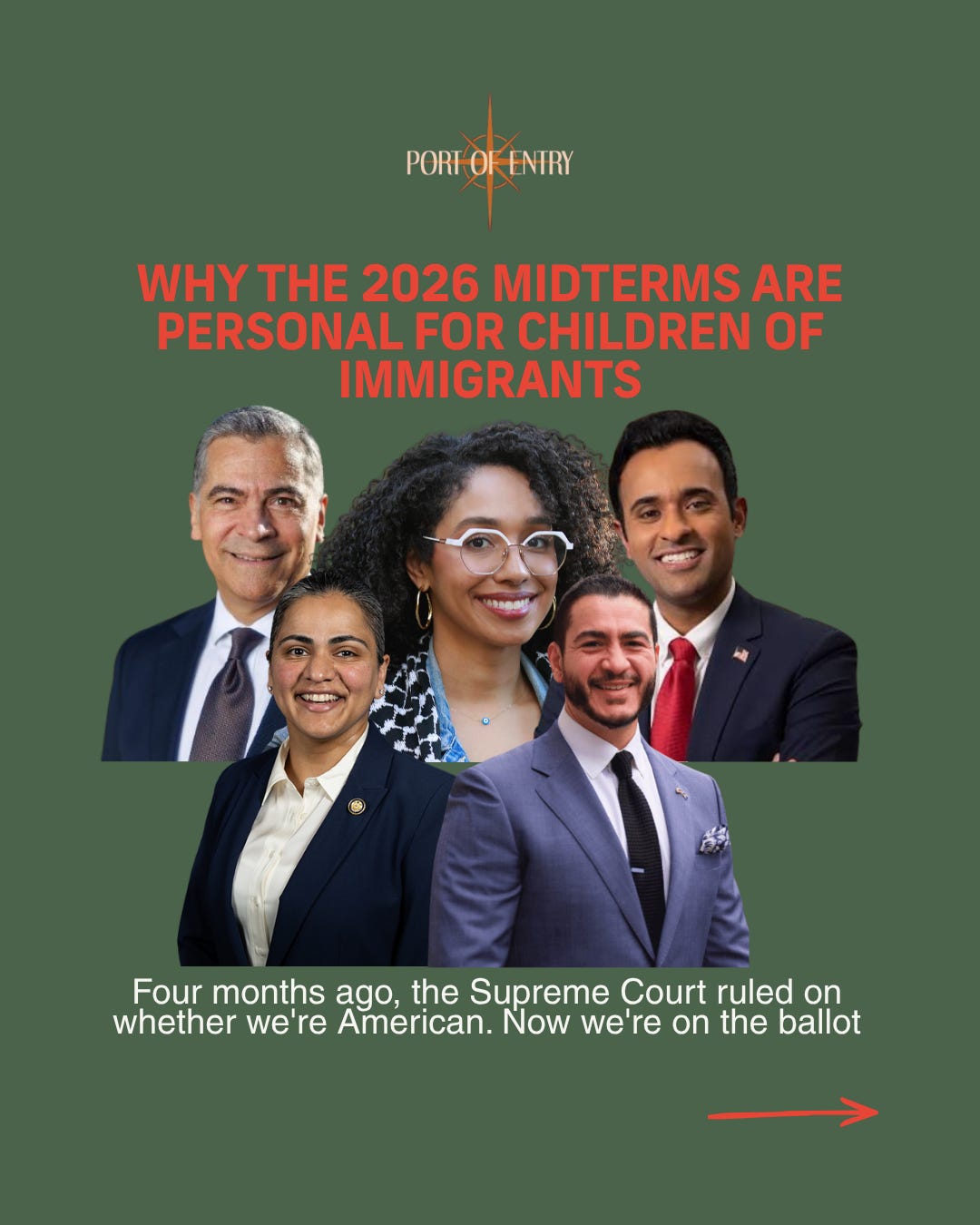
Tomorrow, five races will test what that birthright is worth at the ballot box. The candidates trace their families to Egypt, India, Afghanistan, Mexico and the Dominican Republic.
Five races to watch
1. U.S. Senate, Michigan: Abdul El-Sayed (D) vs. Mike Rogers (R)
El-Sayed’s father immigrated from Egypt. His parents’ immigration has become part of the case against him: a University of Michigan political scientist says Rogers has used it to argue El-Sayed isn’t one of Michigan’s own.
The former Detroit health official narrowly beat Rep. Haley Stevens in the August primary for an open seat, and Stevens endorsed him afterward. Then on Sunday, two days before the election, she endorsed Rogers instead and appeared with him after a service at a Detroit church. The break followed days of fighting over an outside group’s ad. Stevens called the ad antisemitic and demanded El-Sayed condemn it. El-Sayed said his campaign didn’t make it and that he disagreed with its message, and his campaign told her she was no longer welcome at his events.
President Trump celebrated the endorsement in a post that called him “Abdul Mohamed El-Sayed.” Polls were within the margin of error for most of the race, but his lead widened in the final week. The result could decide control of the Senate.
2. Governor, Ohio: Vivek Ramaswamy (R) vs. Amy Acton (D)
Ramaswamy runs with Trump’s endorsement and won his primary with 87% of the vote. A win would make him the third Indian American governor, after Bobby Jindal and Nikki Haley.
3. U.S. House, California’s 14th: Aisha Wahab (D) vs. Melissa Hernandez (D)
Wahab’s parents fled the Soviet invasion of Afghanistan. Both died when she was young, and she spent part of her childhood in foster care. In August, she won a special election and became the first Afghan American in Congress. Tomorrow she faces Hernandez again, in a district that now adds about 26,000 voters who didn’t vote in August.
4. Governor, California: Xavier Becerra (D) vs. Steve Hilton (R)
Becerra’s mother came from Guadalajara at 18. His father, born in Sacramento and raised in Tijuana, spent decades as a construction laborer. The former Health and Human Services secretary leads by more than 20 points in recent polls and would be California’s first elected Latino governor. His opponent, a former Fox News host born in London to Hungarian refugees, has made the immigrant story itself a campaign issue, arguing that he, not Becerra, is the real immigrant in the race.
5. U.S. House, NY-13: Darializa Avila Chevalier (D)
Avila Chevalier is an Afro-Latina daughter of Dominican immigrants who ran on abolishing ICE. In June she unseated Rep. Adriano Espaillat, the first formerly undocumented immigrant to serve in Congress. The district is safely Democratic, so the real contest happened in the primary. Tomorrow should confirm a hotly-contested generational handoff within one diaspora, between two generations who disagree about where to go next.
Why the second generation matters
The second generation is where immigration stops being a policy debate and becomes the country itself.
This year showed how hard some of the country is pushing back. Our citizenship went to the Supreme Court. One candidate’s eligibility was challenged over his parents’ paperwork. Another’s opponent argued his immigrant story doesn’t count. America is becoming more diverse faster than its institutions are willing to reflect it.
La Guardia won by 357 votes because the people who believed in him made sure they were counted. A century later, his political descendants are still asking the same thing: to be counted, and not questioned, for the families they came from. Whoever wins tomorrow, the second generation is already deciding what America looks like. The question is whether the country will admit it.